
The “Future of Work” is Here
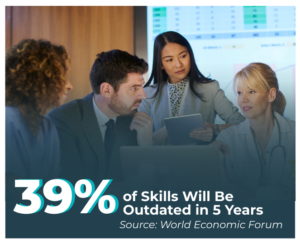
For more than a decade, there have been discussions about the need to prepare young people for the “Future of Work,” taking into consideration the impact of automation, AI, and societal changes on the employment prospects of the next generation. With the explosive growth of Generative AI in recent years, it’s apparent that the Future of Work is here, with some jobs already being eliminated due to the growing influence of these technologies. In fact, in its 2025 Future of Jobs Report, The World Economic Forum predicts 39 percent of current skillsets will be outdated in five years due to advances in AI.
The Impact on Economic Mobility and Generational Outcomes
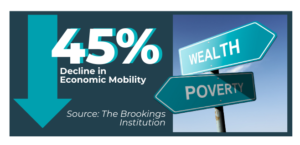
Such advances in technology can have an adverse impact on the economic mobility of those unprepared for these changes. In fact, in recent decades the economic mobility of Americans – the ability to do as well or better than previous generations – has declined 45 percent, according to the Brookings Institution, due, in part, to previous technological innovations, like automation and information systems.
The decline in mobility can be linked to the growing impact of technology and globalization on earning potential. There was a time up until the early 1980s when a high school education was enough to sustain a quality standard of living in the U.S. Today, though, even a college education might not be enough as more than a third of college graduates are “underemployed,” meaning they work in jobs that don’t require a college degree, and that may also pay less than a living wage. Recent advances in AI are threatening to negatively impact access to entry-level and even mid-level jobs for millions of Americans, contributing to downward pressure on economic mobility for this and future generations.
Education for What’s Next
Research by Georgetown University indicates that by 2031, 70 percent of jobs will require education or training beyond high school. Currently, though, only one-in-three high school graduates go on to complete a college degree, with many of those being in fields that are not in high earning, high growth professions.
So, what’s the response to this challenge? According to the Camber Collective, the top four life experiences expected to positively affect lifetime earnings are 1) completing secondary education, 2) graduating with a degree in a high-paying field of study, 3) receiving mentorship during adolescence, and 4) obtaining a first full-time job with opportunity for advancement. Job skills training and business ownership can also be beneficial. These experiences can contribute to gaining the transferable skills and competencies, such as creative and critical thinking, problem-solving, collaboration, and continuous learning, needed to succeed in our rapidly changing economy.
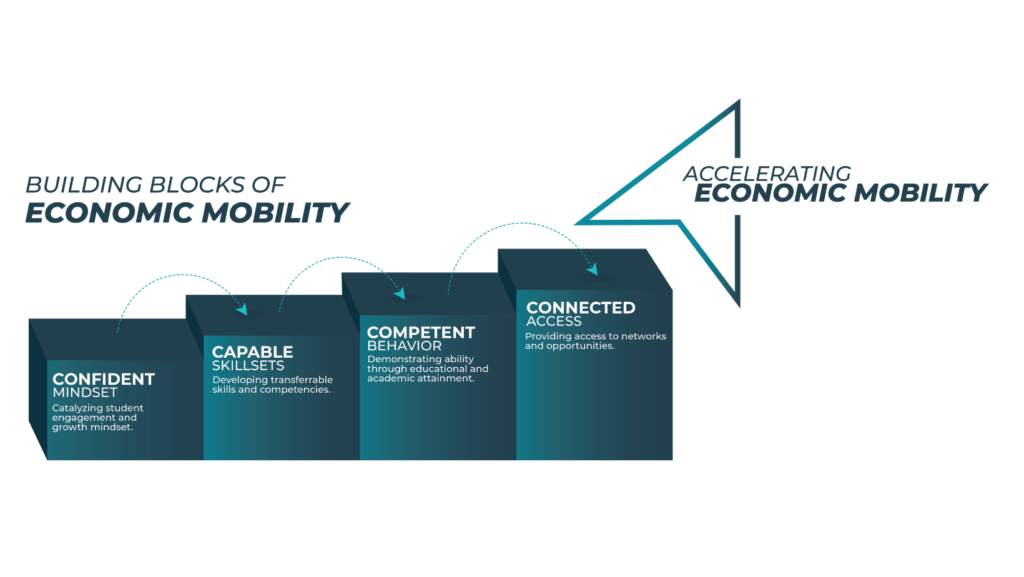
At Junior Achievement of Greater Kansas City, our learning experiences are demonstrated to promote the skills and competencies needed to promote economic mobility. We believe every student deserves a future filled with choices and opportunities. That’s why we focus on what drives real economic mobility by helping students become confident, capable, competent, and connected.
Through career-connected learning, we help students:
- Build Confidence – Cultivating mindsets that spark engagement and belief in their potential.
- Gain Capability – Developing transferable skills and competencies for a changing world.
- Show Competence – Reinforcing behaviors through academic achievement and applied learning.
- Get Connected – Expanding access to networks, mentors, and meaningful opportunities.
By partnering with schools and communities, we unlock potential and accelerate mobility at scale while expanding access to opportunity-filled futures. In this way, Junior Achievement promotes education for what’s next.
At Junior Achievement of Greater Kansas City, we are creating access to opportunity-filled futures. Learn more about how JA is equipping students for what’s next and get involved. Contact us today at 816-561-3558 or info@jagkc.org.